Business leaders, educators, and policy experts from across the Thames Valley came together recently at the Thames Valley AI Skills and Workforce Forum, to explore how artificial intelligence is reshaping workforce skills and what employers, educators and policymakers must do next to ensure no one is left behind.
The sold-out event, delivered by the Thames Valley Chamber of Commerce Skills Unit in partnership with the Thames Valley AI Hub (TVAI), focused on turning AI ambition into real business impact while addressing growing skills gaps, inequality, and ethical challenges.
Opening the forum, speakers highlighted that while skills provision can sometimes feel transactional, AI skills are fundamentally people driven. Successful adoption depends not only on technology, but on workforce confidence, inclusion, and strong collaboration between employers and education providers.
The forum highlighted the work of the Thames Valley Skills Unit in bringing employers closer to education, ensuring training is engaging, relevant and aligned with real workforce needs.
A keynote presentation by Dr Nisreen Ameen, Associate Professor at Royal Holloway, University of London, explored findings from the national report AI Skills for the UK Workforce, published in October 2025, with a follow-up report due in March 2026. Supported by the British Academy and Skills England, the research highlights a growing gap between employer demand for AI skills and workforce readiness.
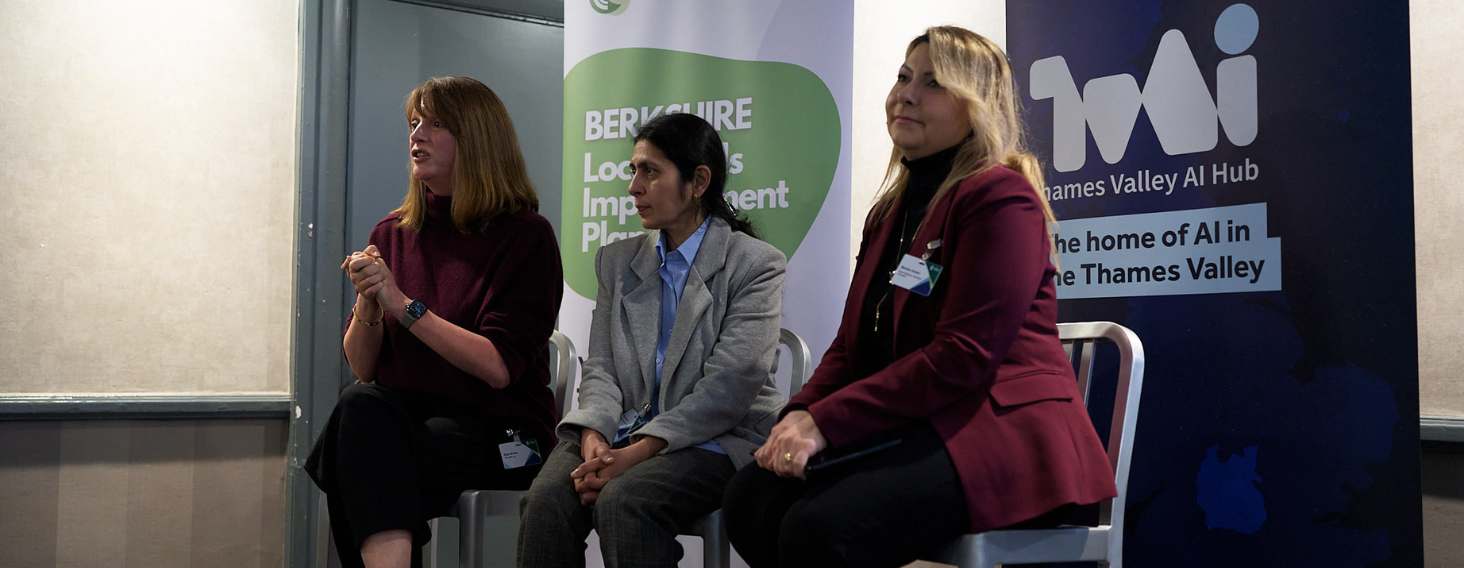
Dr. Mona Ashok, Associate Professor of Digital Transformation, Henley Business School then joined Dr Ameen for a panel session which kept the discussion grounded in what actually matters: AI literacy, responsible AI, governance and real-world deployment – all critical to ensuring that AI adoption happens safely, ethically and effectively across the Thames Valley.
“AI literacy is like learning to swim: everyone needs the basics to stay afloat, some will go further, and a few will become experts – similarly, understanding AI and GenAI is essential for all, especially the next generation.” – Dr Mona Ashok
The forum heard that AI skills maturity varies significantly by sector. Social care remains largely dependent on individual motivation rather than organisation-wide strategies, while construction faces challenges due to low baseline digital skills, an ageing workforce and SME-led delivery models. In contrast, highly regulated sectors such as life sciences rely heavily on long academic training routes, with limited access to practical, modular AI training.
Speakers also addressed major barriers to AI adoption, including the lack of a shared definition of “AI skills,” difficulties in scaling upskilling across organisations, and the risk that AI could deepen existing inequalities. Evidence shows women and those experiencing digital poverty are less likely to access AI training, while biased data can reinforce existing societal disparities if left unchecked.
A fireside discussion reinforced the message that many organisations simply do not know where to start. Delegates called for clearer minimum standards for AI literacy, more flexible short-course provision, and practical tools to help employers embed AI ethically and sustainably. AI was repeatedly described not as a replacement for people, but as a tool that must be learned, tested and used responsibly.
The event concluded with a call to action for employers to look beyond short-term pressures, develop AI plans alongside business strategies, and work collectively with peers and education providers to build future-ready workforces. Insights from the forum will directly inform the next phase of the Local Skills Improvement Plan (LSIP) for the Thames Valley.