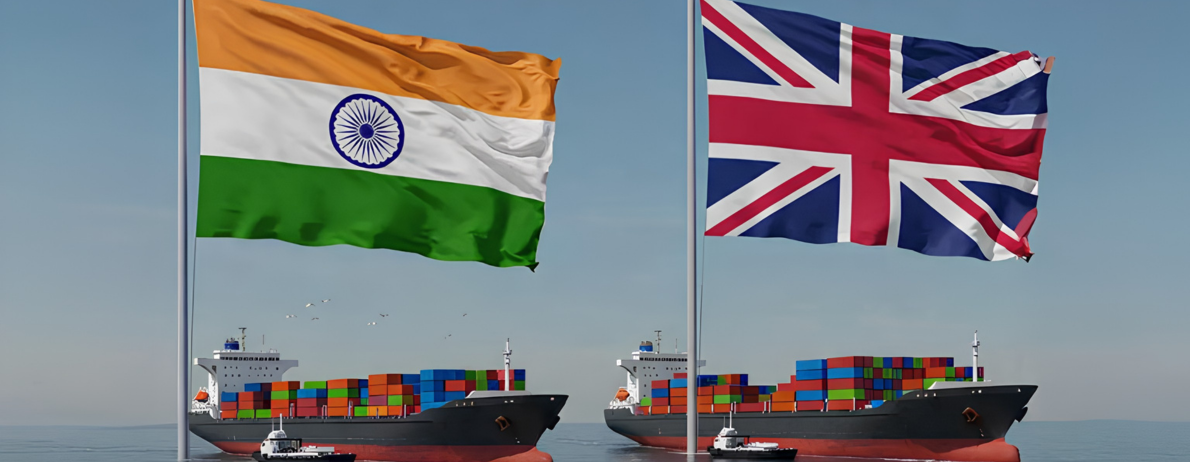
The UK-India Free Trade Agreement will enter into force on 15 July 2026. As at 26 June 2026, businesses have 19 days to prepare for new tariff opportunities and origin procedures. Preferential treatment will not apply automatically.
Agreement takes effect in July
The Government has confirmed that businesses can trade under the agreement from 15 July 2026. It estimates that the deal could increase UK GDP by £4.8 billion and bilateral trade by £25.5 billion a year in the long term.
Headline tariff changes include reductions for UK automotive exports under a quota, lower duties on whisky and the removal of tariffs on some cosmetics. UK importers may also benefit from lower duties on eligible Indian goods, including certain clothing, footwear and food products.
Businesses should check the tariff treatment for their precise commodity codes. Product coverage, staging periods and quotas vary, so commercial decisions should not be based on headline figures alone.
Origin registration and declarations
UK producers and exporters intending to complete origin declarations for qualifying exports to India must register with HMRC before issuing those declarations. Registration requires the business’s EORI number, trading name and approved email addresses.
The agreement allows eligible UK exporters to self-certify origin rather than obtain an origin certificate for each consignment. However, the goods must satisfy the relevant rules of origin. Depending on the product, this may require proof that it was wholly obtained, made from originating materials or sufficiently processed under a product-specific rule.
For every consignment using an origin declaration, the exporter must complete the Annex 3B template and send it to both the importer in India and the Indian customs authority. An unregistered exporter’s declaration may be rejected, preventing the importer from claiming the preferential tariff.
What businesses should do
Manufacturers, technology firms, life sciences businesses and specialist food and drink exporters should review planned India shipments now. They should confirm commodity codes, compare standard and preferential duty rates, assess the relevant product-specific origin rule and document supporting supplier information.
Businesses should also check that the email addresses used for origin declarations are registered against the correct EORI number. Records supporting origin claims must be accurate, accessible and retained for at least five years.
How TVCC can help
TVCC’s India Desk provides specialist support for businesses seeking to enter or expand within the Indian market. Its services include market-entry planning, regulatory guidance, sector intelligence and introductions to government bodies, local agencies and trusted business partners.
This market-focused assistance is supported by TVCC’s wider International Trade team. Businesses can access Rules of Origin Guidance to assess whether their products qualify for preferential tariffs, alongside customs consultancy, documentation support. Training workshops are also available for companies that need to strengthen their internal knowledge of origin, classification and customs procedures.
For support, contact the International Trade team on 01753 870560 or email trade@tvchamber.co.uk
Find out more about the India Desk here
Explore TVCC International Trade services here