The Thames Valley Chamber of Commerce’s (TVCC), business-led, curated industry network, the Thames Valley Health and Life sciences working group (HLSWG) met yesterday for the first time this year to discuss the topic of Women’s Health.
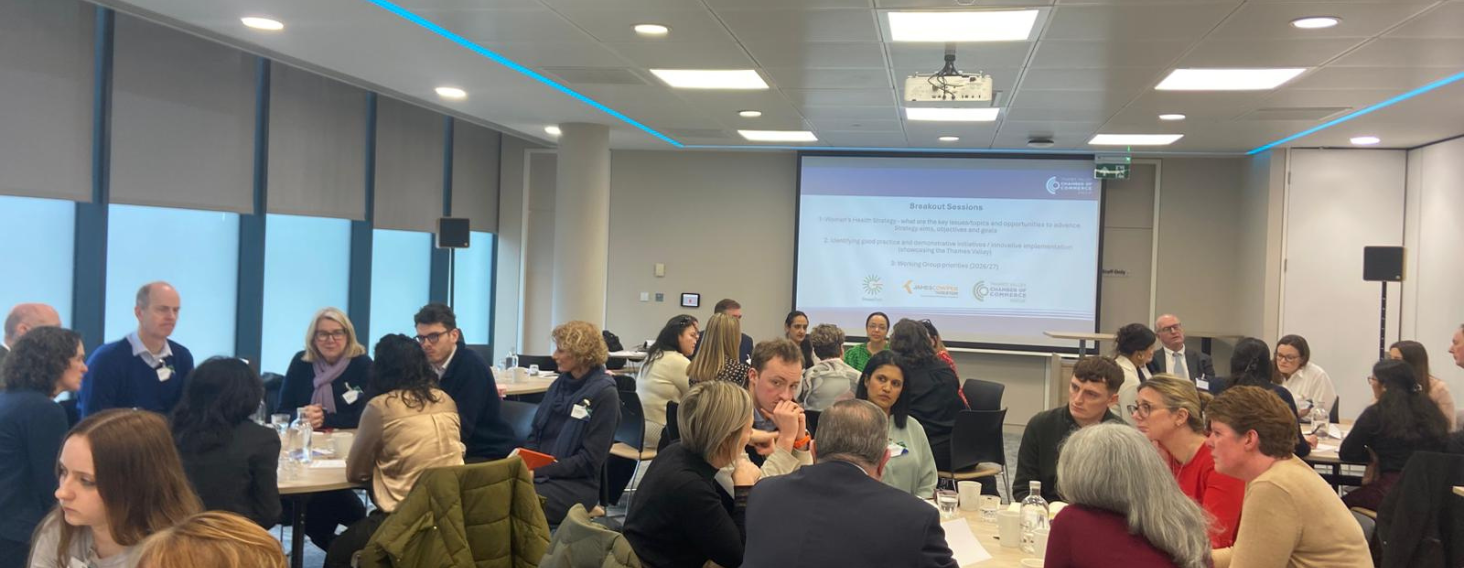
Hosted in partnership with James Cowper Kreston and Green Park, Reading, the group brought together over 70 delegates to explore the issues affecting half the population and discussed the challenges, scale and impact of inequalities in Women’s Health.
Sue Staunton, Managing Partner and Head of Life Sciences at James Cowper Kreston and Chair of the HLWSG, said: “Our working group is deliberately action-led and business-driven. Women’s health is one of several priorities where the Thames Valley has the capability to lead, showcase good practice and drive collaborative, commercially driven, solutions that can support the delivery of the ambition government has set-out in its NHS 10-Year Plan. The HLSWG is speaking for the region’s life sciences business community. We have a proven track record and a growing reputation, lobbying government to champion improved patient care and outcomes; and driving policy reform”
Gareth Ralphs, Head of Business Representation and Policy, TVCC added “It is evident that industry, practitioners and academics recognise that addressing inequalities in Women’s Health is a significant challenge, but one that demands a collective action and long-term commitment from the HLSWG – we stand mobilised and ready”.
The group examined the economic and societal case for accelerating action on Women’s Health, highlighting the urgency of addressing these gaps and committing to work together to support the HLSWG deliver the next steps. Members shared evidence, insights and examples of good practice, from across the region, reinforcing the message that women continue to experience disproportionate levels of ill-health, under-diagnosis and under-investment, and that meaningful change requires coordinated action.
Jane Lewis, Chief Operating Officer and Chief Financial Officer at the Association of British HealthTech Industries, highlighted the importance of embedding women’s health at the heart of innovation, policy and system reform, said, “Women’s Health is not a niche issue – it is fundamental to tackling health inequalities, improving productivity and delivering sustainable economic growth. The life sciences sector has a critical role to play in addressing the historic biological bias in research, data and innovation”.
Katherine Edwards, Director of Patient Safety and Clinical Improvement at Health Innovation Oxford and Thames Valley, added: “Forums like the TVCC’s HLSWG are powerful because they bring together industry, the NHS, academia, practitioners and policymakers to turn evidence and insight into practical action.”
Emily Mitchell, Head of Therapeutic Areas Public Affairs, Bayer UK, who shared thoughts on re-framing care around women, who considered policy challenges and opportunities, commented “The refresh of the Women’s Health Strategy offers an important opportunity to build on what’s working and embed a model of care for women health that is centered around their needs”.
Dr Shilpa McQuillan, Clinical Lead and Director of the Berkshire Menopause Clinic and NHS Clinical Lead of Women’s Health Services, Berkshire West drew on her frontline clinical experience to underline the real-world impact of these inequalities on women and health services, adding: “Every day, women present with symptoms that have been normalised, dismissed or misunderstood for far too long. Whether it’s menopause, gynaecological conditions or chronic pain, the consequences of delayed diagnosis and fragmented care are profound – for women, for families and for the NHS – addressing Women’s Health inequities is not only a moral imperative, but also essential for a resilient and effective healthcare system.”
Next steps
Following the publication of the 10-Year Health Plan, government outlined its ambition to improve women’s healthcare and create a system that listens to women’s experiences and tackles the inequalities they face. The new Women’s Health Strategy is shortly due for publication and will set out what next steps government will take to improve access and tackle these inequalities.
The group has the opportunity to potentially inform and shape this strategy, in the same way it did when commenting on the Industrial Strategy. Building on the group discussion, further input was invited to help prepare a TVCC submission on behalf of the HLSWG.
In addition to the broad policy issues and need for sustained funding, this will focus on:
- Implementation and the practical action/s that can tackle longstanding inequalities in women’s health.
- Showcasing examples of good practice from across the Thames Valley.
- Identifying commercially driven solutions and collaboration that the Thames Valley can pilot and will contribute to national ambition/s for an NHS Fit for the Future.
- Outlining the economic imperative, to UK plc and economic growth. Closing the Women’s Health gap could deliver £32 billion to the UK economy each year, with every £1 invested returning an estimated £11.
Key Facts
- Women spend 25% more of their lives in poor health compared with men.
- Only 5% of global research funding is directed towards women’s health.
- Closing the WH health gap could deliver £32 billion to the UK economy each year.
- There are currently 600,000 women on gynaecology waiting lists, the fastest-growing backlog in the NHS.
- Every £1 invested in women’s health returns an estimated £11 to the economy.
About the HLSWG
TVCC is proud to host the Thames Valley’s only region-wide, curated, Health and Life Sciences working group.
The industry-led group serves as a vital platform for collaboration, convening global corporates, innovative SMEs, academic institutions and educational establishments (including those linked to our LSIP), NHS trusts, government stakeholders, professional bodies and pre-eminent thought leaders.
Business-led, the group is Chaired by Sue Staunton, Managing Partner at James Cowper Kreston and hosted by Green Park, Reading.
The HLSWG is an invitation only meeting. We welcome expressions of interest from organisations (members and non-members of the Chamber) with direct knowledge, expertise and experience in life sciences and an operational link to the Thames Valley.
- For Chamber members, to express your interest in attending please contact your account manager.
- For non-member businesses, please contact BRP@tvchamber.co.uk